Growing Factors Beyond USDA Hardiness Zones in Arid Nevada Gardens
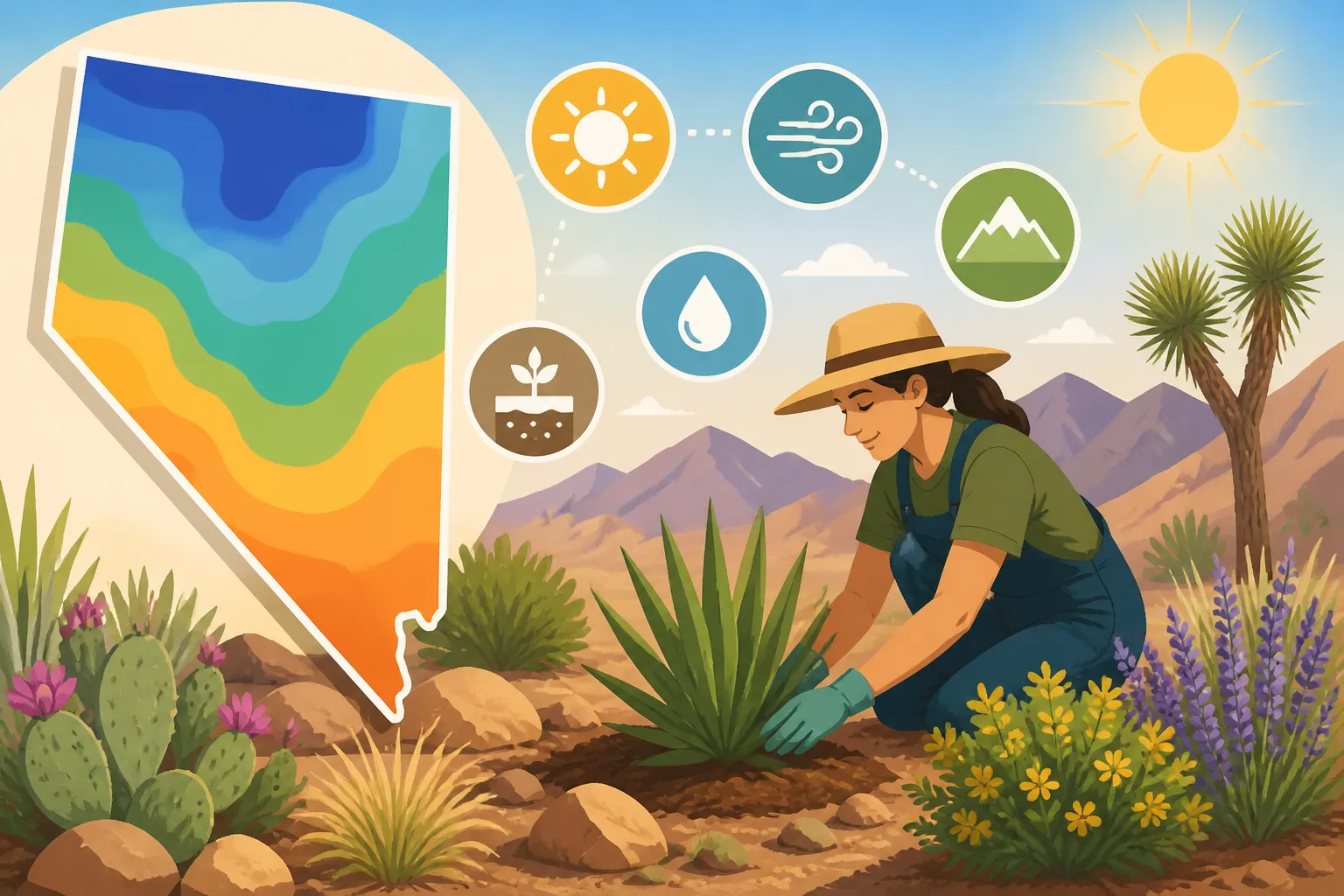
USDA hardiness zones can help you choose plants that survive winter, but they cannot tell you when to sow vegetables or protect them from Nevada’s spring freezes and summer heat. In arid Nevada, elevation, local frost patterns, soil temperature, water, and wind all shape the planting calendar. Use these factors together to make better decisions for your own garden.
What USDA hardiness zones can and cannot tell you
The USDA Plant Hardiness Zone Map groups locations by average annual extreme minimum winter temperature. It is useful for comparing how well perennial plants, shrubs, and trees may tolerate winter cold. It is not a planting calendar, a guarantee of survival, or a measure of how long a vegetable has to mature.
A ZIP code or area falls in a zone on the USDA Plant Hardiness Zone Map, but the map cannot account for every garden within that area. A sheltered yard, an exposed slope, and a low spot where cold air settles may have different winter conditions. Even a plant that is hardy in a particular zone can struggle if it is planted in a poorly drained site, hit by strong wind, or weakened by heat and drought.
For annual vegetables, the zone is often less useful than the conditions you need to manage during the growing season. A warm-season crop might tolerate the winter minimum for a few weeks and still fail to produce if spring stays cold or summer heat arrives before the fruit sets. A cool-season crop might survive a light frost but bolt or turn bitter when hot weather sets in.
| Garden question | Does a hardiness zone answer it? | More useful information |
|---|---|---|
| Is a perennial likely to tolerate winter cold? | It offers a helpful starting point. | Local winter lows, exposure, drainage, and establishment |
| When can I sow peas or greens? | No. | Soil workability, soil temperature, and expected frost |
| When should I transplant tomatoes? | No. | Night temperatures, soil warmth, forecast, and cover options |
| How long can a crop mature before frost? | No. | Local frost-free window and the crop’s days to maturity |
| Will a plant cope with a hot, dry site? | No. | Heat tolerance, sun exposure, soil, wind, and irrigation |
This distinction matters across Nevada, where the same zone label does not mean the same growing conditions. A garden at higher elevation may face a short, cool season, while a lower, warmer site may have a longer planting calendar but more severe summer heat and water stress. A gardener using a zone as a complete schedule can end up planting tender crops too early or trying to sow cool-season crops when heat is already building.
Use zone information as one part of a plant-selection decision. Then check the local planting conditions that determine when a crop can actually grow. For a closer look at how the map works, see How to Read the USDA Plant Hardiness Zone Map in Nevada. For the broader regional picture, Nevada Regional Planting Guide: Elevation and Microclimate Shifts explains why nearby gardens can have different growing windows.
Nevada’s geography creates different garden calendars
Nevada is not one uniform garden climate. Elevation, terrain, and exposure can change temperatures and frost behavior over short distances. That means a calendar written for a broad region is a starting point, not a promise for every yard.
Higher-elevation gardens and cold basins often have a shorter warm-season window than lower, warmer valleys. Spring warmth can arrive later, and the first fall freeze can arrive sooner. These gardens may be especially well suited to crops that mature quickly or tolerate cool conditions. Gardeners may need to start some crops indoors, use covers, and choose varieties with shorter days to maturity.
Lower desert gardens face a different balance. They may be able to grow during cool parts of the year, but extreme summer heat can interrupt production. A crop that needs a long, mild period may struggle when daytime temperatures rise sharply or nights remain hot. In those areas, gardeners often need to plan around more than one useful growing period rather than assume that a longer frost-free season means easy summer production.
A yard’s position within the landscape matters too:
- Low spots and enclosed areas can collect cold air on clear, calm nights. These frost pockets may freeze earlier or more often than nearby higher ground.
- Slopes can drain cold air downhill, but exposure and slope direction also affect sun and warmth.
- North-facing areas tend to receive less direct sun and may warm more slowly in spring.
- South- and west-facing walls can create warmer pockets, but reflected heat may stress plants during hot weather.
- Open sites can be exposed to drying winds that increase moisture loss and damage tender leaves.
- Courtyards and sheltered corners may retain warmth, though they can also trap heat and limit air movement.
Observe the garden rather than assuming the conditions match a nearby weather station or a regional planting chart. A simple record of where frost lingers, where snow melts first, and which beds dry out fastest can help you refine your calendar over time. Keep notes by bed or container, not just by address. A sheltered raised bed against a wall may behave differently from a ground-level plot a short distance away.
Microclimate observations are most valuable when paired with local frost information. Weather stations provide useful norms, but they do not measure the exact conditions at every home. A station’s reported average last spring freeze is a probability, not a fixed date. The date can vary from year to year, and a garden’s local topography can shift its risk. Tracking Late Winter Freeze Dates Across Southern Valleys and Tracking Spring Freeze Dates Across High-Elevation Basins cover those regional differences.
Frost and growing-season length set the planting window
A crop needs suitable conditions for more than the day it is planted. It has to germinate or establish, grow through its vulnerable early stage, and reach harvest before cold or heat makes production unreliable. That is why the frost-free window is often a better scheduling tool than a hardiness zone for vegetables.
A frost date is not a guaranteed cutoff. Weather stations calculate probabilities from observations over a period, and a date with a particular chance of frost still leaves a meaningful chance of a different outcome. Use the probability attached to a date, the station or period it represents, and your garden’s microclimate. Do not treat a calendar date as a promise that frost is finished. For more detail, see Nevada Weather Station Freeze Dates: Spring and Fall Guide.
Crop tolerance varies. Peas, spinach, and some other cool-season crops can generally handle cooler conditions than tender crops such as tomatoes, peppers, and squash. But “cold tolerant” does not mean immune to every freeze, and a plant’s response depends on its stage, exposure, and how quickly temperatures drop. Young transplants may be more vulnerable than established plants.
A practical way to plan is to work backward from the conditions a crop needs:
- Check the crop’s temperature needs. Separate crops that can grow in cool soil from those that need reliably warm soil and nights.
- Estimate the local frost risk. Use nearby weather-station information as a guide, then adjust for your own cold pockets and sheltered areas.
- Allow for establishment. A direct-sown seed and a hardened-off transplant do not start from the same point.
- Compare the crop’s days to maturity with the available window. Treat the seed packet’s maturity information as an estimate, since stress and local conditions affect growth.
- Plan for protection or a backup. Row covers and low tunnels may buffer some cold, but they do not remove every weather risk.
For spring crops, soil conditions can be as important as air temperature. A bed that is cold, wet, or difficult to work may delay germination and encourage poor establishment. A calendar date alone cannot tell you whether the soil is ready. Scheduling Vegetable Sowing by Soil Workability and Temperature explains how to use those cues alongside the calendar.
The same logic applies in fall. Count backward from the expected fall freeze window, allowing the crop enough time to germinate, grow, and reach a useful harvest stage. Add extra time if the crop will grow in cooler, shortening days. A crop that matures quickly in summer may take longer in autumn. For a step-by-step approach, see Calculating Fall Crop Sowing Dates from Nevada Freeze Normals.
This approach also helps avoid treating “last frost” as the only date that matters. A warm-season crop may need warm soil and settled nights well after a likely last spring freeze. Conversely, hardy crops may be sown while the risk of frost remains, if the crop and conditions are suitable. The goal is not to find a single perfect date; it is to match the crop to the conditions it needs and have a response ready if the weather shifts.
Heat, sunlight, and wind can shorten or disrupt the season
A long period without freezing weather does not necessarily mean a long period of productive growth. In arid Nevada gardens, heat can prevent fruit set, slow or stop growth, make leaves wilt, and reduce the quality of leafy crops. A planting calendar that only tracks freezes misses an important part of the season.
Cool-season crops often have a limited window before increasing heat pushes them to bolt, flower, or decline. If you sow them too late in spring, they may not produce much before hot weather arrives. In warm regions, a fall or winter growing period may be more productive for these crops than midsummer. In cooler or higher gardens, the season may stay mild longer, though fall cold can arrive sooner.
Warm-season vegetables have their own temperature limits. Tomatoes, peppers, beans, and squash need warmth, but excessive heat can also interfere with growth or fruiting. Hot nights may be as important as hot afternoons. When a crop is struggling, planting more of it does not solve a site that is too hot, too exposed, or short on water.
Sunlight varies in both intensity and duration. A location with full sun can be helpful in a cool garden but punishing during intense afternoon heat. Walls, paving, and rocks can radiate warmth long after the sun moves away. Containers may heat up faster than garden soil, especially when their sides are exposed. Where heat is the main problem, temporary shade or adjusted planting timing may help, but shade that is too dense can limit growth. How to Shield Desert Vegetables from Sun and Heat discusses ways to protect plants without assuming that every bed needs the same treatment.
Wind is another calendar factor because it can dry soil and foliage, bend or break young plants, and make cover structures less effective. Wind exposure can make an otherwise suitable spring day harder on newly transplanted seedlings. A protected location, sturdy supports, and well-secured covers can reduce some of the risk. Avoid placing a tender crop where it receives the brunt of prevailing winds simply because the bed is convenient.
Use the following seasonal pattern as a planning framework, not a statewide set of dates:
| Growing period | Typical planning focus | What to watch |
|---|---|---|
| Early spring | Cool-season sowing and soil readiness | Cold soil, wet beds, lingering freezes |
| Late spring | Transition to warm-season crops | Night temperatures, soil warmth, wind |
| Summer | Heat management and steady irrigation | Hot nights, sun exposure, rapid drying |
| Late summer | Fall crop sowing | Germination heat and time before frost |
| Autumn | Harvest and protection | Shortening days, cold snaps, crop maturity |
| Winter in warmer areas | Cool-season production where conditions allow | Frost exposure, slow growth, dry soil |
This seasonal framework needs regional adjustment. A high-elevation garden may have a brief warm period and need to prioritize quick-maturing crops. A warm low-elevation garden may get a better cool-season harvest in fall or winter than during summer. For broad seasonal comparisons, see Nevada Vegetable Planting Calendar Across Three Growing Seasons. For the challenge of extreme summer conditions, How to Keep Summer Vegetables Alive During Extreme Desert Heat offers more focused advice.
Soil and water determine whether planting dates work
Seeds and transplants need a suitable root environment. Nevada soils can vary widely, and dry conditions make it especially important to understand how each bed holds and drains water. A calendar can tell you when a crop might fit the season, but not whether your soil is ready to support it.
Soil texture affects both moisture and temperature. Sandy soil drains quickly and may dry rapidly, while finer-textured soil can hold water longer and may be slower to warm or dry after irrigation. Compacted or poorly drained ground can leave roots short of air. Raised beds may drain and warm differently from in-ground beds, and container mixes behave differently again.
The best sowing conditions are not simply “dry enough” or “warm enough” in every garden. Soil that is waterlogged or cloddy can be hard to prepare and can slow seed establishment. Soil that is very dry at sowing can make it difficult to keep a consistent moisture level as seeds germinate. Before planting, check the bed itself rather than relying on recent rainfall or a broad weather forecast.
Water availability shapes crop choice and timing. In an arid climate, a newly sown bed may need closer attention than an established planting because seeds and seedlings have shallow roots. A mature plant can reach farther into the soil, while a newly transplanted start may dry out quickly. Watering needs also shift with weather, plant size, soil, and irrigation method. There is no one schedule that fits all beds.
When heat rises, irrigation may need adjustment, but more water is not always the solution to wilt. A plant may wilt because roots are damaged, the soil is too wet, or heat demand temporarily exceeds what roots can supply. Check soil moisture at root depth and look for other signs before changing the irrigation routine. For practical guidance, see How to Check Vegetable Soil Moisture in Nevada Beds and Pots and How Often to Water a Vegetable Garden in Nevada’s Arid Climate.
Soil fertility also affects how a crop responds to its growing window. Excessive or inadequate nutrients can both interfere with healthy growth, and soil conditions influence how available nutrients are to roots. Avoid adding amendments by guesswork, especially when a bed has a history of poor growth or unusual leaf symptoms. Managing Water and Soil Nutrients in Arid Nevada Vegetable Beds covers the relationship between moisture, nutrients, and arid garden soils.
Mulch can help reduce evaporation and moderate soil conditions, but it should not be used as a substitute for checking moisture. A layer that is helpful in one bed may keep another bed too cool in spring or make it harder to assess how wet the soil is. Consider the crop, soil, and season before applying it. For seedlings, keep the immediate sowing area appropriate for germination and avoid letting a dry surface crust interfere with emergence.
Build a planting calendar around your own garden
A useful Nevada planting calendar combines regional guidance with observations from the site. Start with a broad seasonal schedule, then adjust it for elevation, local frost patterns, soil conditions, and crop needs. A few clear records can make next season’s decisions more reliable.
Begin by dividing the garden into growing areas. Note which beds are exposed, sheltered, shaded, windy, slow to warm, or prone to early drying. Include pots and raised beds as separate areas if they behave differently. A short description is enough: “north bed, cold in spring,” or “container row, afternoon sun and fast drying.” The point is to notice repeat patterns.
Next, record a few useful observations through the season:
- When the soil first becomes workable in each bed
- When cool-season seeds emerge and how evenly they germinate
- Which areas show frost damage first
- When warm-season crops begin to grow steadily
- When heat stress appears, especially in the afternoon
- How quickly beds and containers dry after irrigation
- When fall crops reach harvestable size
- Which crops mature before the first damaging cold
Record sowing and transplanting dates alongside harvest dates. If a crop matures much later than expected, note whether the delay coincided with cold soil, heat, wind, or inconsistent moisture. If it bolts early, note how far along the season was and whether it was exposed to afternoon heat. This turns a generic planting recommendation into a practical schedule for your garden.
Use a simple crop-planning sequence:
- Choose the crop and purpose. Decide whether you want an early harvest, a main-season crop, or a fall planting.
- Identify its preferred conditions. Check whether it needs cool soil, warm soil, cool nights, or a long period without frost.
- Select a suitable bed. Match its needs to the garden’s sun, wind, drainage, and heat exposure.
- Set a flexible window. Use local freeze information, soil readiness, and regional planting guidance rather than relying on one date.
- Choose a variety that fits the window. Days to maturity can help, but it is an estimate; shorter-maturing options may be useful where the growing window is short.
- Prepare a weather response. Decide whether you can cover plants, delay planting, sow again, or switch to a different crop if conditions change.
- Review the result. Record what happened and adjust the next sowing.
Succession planting can help spread risk and extend harvests. Instead of sowing an entire bed at once, divide the planting into smaller rounds when the crop and season make that practical. The interval should suit the crop’s growth speed and the weather; a schedule that works during mild conditions may not work as heat or cold changes. For more on this approach, see Staggering Garden Sowings Every Two to Four Weeks to Extend Harvests.
Protection can also widen the range of conditions in which you can garden. Row covers and low tunnels may help buffer cold or wind, while shade can reduce stress during harsh sun. Each tool has limits: covers can trap heat, wind can damage poorly secured structures, and shade can reduce light. Make sure protection suits the forecast and the crop, and check plants underneath it rather than leaving it in place without monitoring. Extending the Nevada Growing Season With Row Covers and Low Tunnels discusses ways to use these structures as part of a local plan.
Finally, keep expectations flexible. Nevada weather can shift from one season to the next, and a planting calendar is a planning aid rather than a guarantee. If a cold spell returns, a heat wave arrives early, or a bed stays wet, adjust the planting decision. Waiting for better conditions or choosing a more suitable crop can be a better use of seed and effort than following a date that no longer fits the garden.
Frequently Asked Questions
Does my hardiness zone tell me when to plant vegetables in Nevada?
No. A hardiness zone estimates average annual extreme minimum winter temperature and helps with perennial plant selection. For vegetables, also consider local frost risk, soil temperature, heat, crop maturity, and the conditions in the specific bed.
Can two gardens in the same area have different planting schedules?
Yes. Elevation, slope, shade, walls, wind exposure, cold-air drainage, and soil can create different conditions even within a small area. Use regional calendars as a starting point and keep notes on how your own beds behave.
Is the last spring frost date a safe planting date for tender crops?
Not by itself. A reported frost date is a probability based on a weather station or observation period, and it varies from year to year. Tender crops may also need warm soil and suitable nighttime temperatures after frost risk has decreased.
Why do vegetables struggle in a yard with a long frost-free season?
Heat, hot nights, wind, poor soil conditions, or inconsistent moisture can limit growth even when freezing temperatures are rare. Some crops perform better in cooler parts of the year than during the hottest months.
Disclaimer
This article is for general informational purposes only and does not constitute professional advice. Laws, prices and regulations vary by location and change over time. Consult a qualified professional for guidance on your specific situation. Nevada Gardening Guide is not a government agency and is not affiliated with any university extension, state department of agriculture or other government agency.